When cloud sits over Alta, the aurora tours that drive on
Cloud spoils more northern lights evenings around Alta than a quiet sun does. This guide explains which tours can drive away from a grey sky and which ride one fixed area, what happens to your money when the sky stays shut, and how to plan your nights so one bad forecast does not end the trip.
Cloud is the usual reason for a blank night
Most failed aurora evenings around Alta come down to cloud, not to a quiet sun. The lights can be active above a grey ceiling and you would never know, since even a strong display cannot shine through a thick layer.
That makes the weather forecast the first thing a guide reads each afternoon. The aurora forecast comes second, and together they decide which direction a minibus or bus takes out of town.
None of the five tours on this site promises a sighting. Treat every booking as a good chance rather than a sure thing, and plan your stay so one closed sky is not your only try.
Why the Kp number matters less than the cloud map
The Kp index is a scale from 0 to 9 that measures how disturbed Earth's magnetic field is. Forecast apps lean on it heavily, and a low number can make travelers give up before they leave the hotel.
At about 70° north, Alta sits roughly under the auroral oval, the ring where the lights appear most often. Here even a modest Kp can put a band overhead, so a clear sky with a low reading usually beats a high reading under cloud.
That is a tendency, not a rule. The K-index is a global measure, and the sky over Finnmark can run quieter or livelier than the number suggests. Our guide to the dark months covers how the moon and the season shift the odds.
Tours that drive and tours that stay put
The five tours split into two groups on a doubtful night. The minibus and the big bus can change direction, while the three activity tours each ride one fixed area whatever the sky does.
Alta Adventure's small-group tour, from ~$257, picks its route from the weather and the Kp forecast and heads wherever the sky looks clearest. Sometimes that means a long drive that ends at a camp with a fire.
On shorter nights the stops are brief, just hot chocolate with snacks by the minibus. Either way the guide spends the evening reading the sky, which is what you pay for on a grey forecast.
Karlsøy's big bus works on a similar idea with more time in hand. Its night can last up to 6 hours depending on the route, and on quiet nights the group moves to a smaller vehicle. The campfire tour from ~$129 is the cheapest seat that can still move.
Inland air often helps both of them. Clouds rolling in off the sea tend to thin out over Finnmarksvidda, which is why drivers so often head up the valleys. Our plateau guide explains the pattern and where it stops working.
A night out even without the lights
The activity tours cannot chase a gap, but they still give you an evening under cloud. Æventyr's snowmobile ride, from ~$284, is about two hours of driving up the old postal road to Beskardes whatever the sky shows.
Flatmoen's horse sleigh keeps its three-course dinner by the fire, and Finnmark Adventure's quad still runs along the coast at Kviby. If a grey sky would ruin the night for you, pick a vehicle tour. The ride comparison lines up all five shapes.
The tour built for an uncertain sky
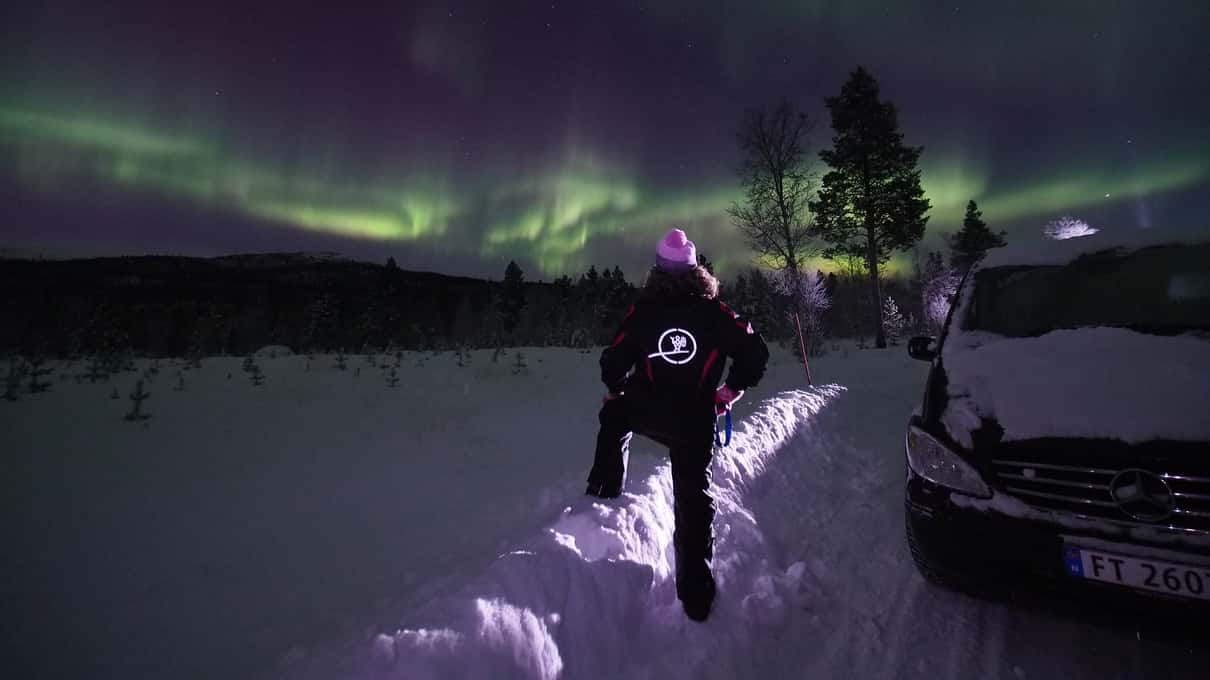
Alta Adventure takes up to 13 guests in a minibus and drives toward the clearest patch it can find. Warm suits and boots are lent, and it goes out in any weather short of dangerous conditions.
What happens to your money
Alta Adventure runs regardless of the weather. It cancels only when the weather or the roads make driving dangerous, and in that case you get a full refund.
A tour that runs and sees nothing is a different case. None of the listings refunds a night that went ahead as planned, and none promises a free second attempt, so the price buys the guide's effort rather than the result.
Your own cancellation is the flexible part. All five tours allow free cancellation on GetYourGuide up to 24 hours before the start, so a hopeless forecast a day ahead still lets you move. Our cost guide adds up what a second try would set you back.
Reading the sky yourself
Most travelers check two things before a tour. A cloud forecast shows how much of the sky is covered at different heights, and an aurora forecast gives the Kp and the solar wind.
Low cloud is the worst kind, because it blocks everything. Thin high cloud sometimes lets a bright display through as a soft glow, which a camera picks up better than the eye, since faint aurora looks grey-white in person and green on a sensor.
Gaps move quickly in a fjord landscape. A sky that looks shut from your window at 8 pm can open an hour later, which is one reason the drivers stay out late. The Wikipedia page on the aurora covers the science if you want it first.
Planning your nights in Alta
The plan that works best is simple. Book your tour for your first evening in Alta and keep the next one or two nights free. Then a cancellation or a blank sky still leaves room for another go.
On a doubtful forecast, a tour that drives gives you better odds. On a clear forecast the snowmobile or the sleigh adds a ride to the sky, and a fixed area matters far less.
Clear nights are also the coldest, so pack for them whatever you book. Our clothing guide covers the layers, and the first snowmobile night walks through Æventyr's ride if the sky looks promising.
A cloudless sky over Alta is no promise of the lights either. Even on a clear night the aurora can stay faint or absent. That is why two or three nights beat one.